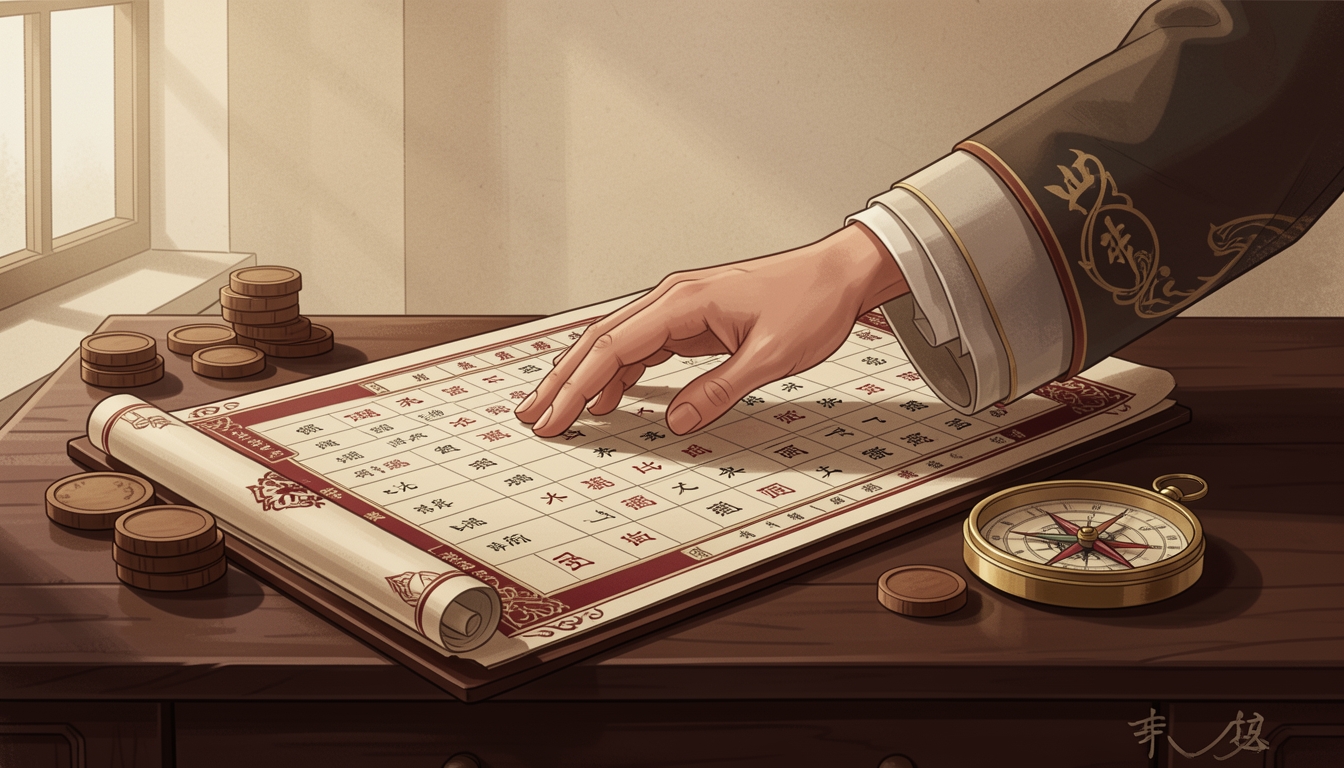
Reading a BaZi chart is like reading a landscape: you start with the biggest features, then move toward the details. Beginners often feel pressure to memorize everything at once. This walkthrough offers a calmer order. If you follow it, you will be able to look at any chart and say something honest about its structure, not just its symbols.
Start With the Day Master
The Day Master is the stem of the Day Pillar. It represents the person the chart is describing. Everything else in the chart is read in relationship to it: what supports the Day Master, what drains it, what controls it, and what it produces. Before any other step, identify the Day Master and its element and polarity. That single piece of information anchors the whole reading.
For example, a Yang Wood Day Master has a different temperament from a Yin Metal Day Master, even when their other pillars look similar. The Day Master is the lens through which every other symbol is interpreted.
Look at Element Balance
Next, count how strongly each of the five elements appears across the eight characters. Some charts are heavily Wood or Fire; others are dry in support and heavy in control. The balance is not about "good" or "bad." It is about context. A chart with little support for the Day Master may indicate a person who must build external resources carefully. A chart with abundant support may indicate natural stamina, but also a tendency to resist change.
Season matters here too. The Month Pillar gives the chart its season, which strengthens or weakens elements in predictable ways. A Water Day Master born in winter is in a very different position from one born in summer.
Notice the Ten Gods
The Ten Gods are the relational names given to each stem and branch relative to the Day Master: Resource, Output, Wealth, Officer, and Companion, each in Yin and Yang form. They are not deities. They are roles. Resource describes support and learning. Output describes expression and creativity. Wealth describes value and acquisition. Officer describes structure, duty, and regulation. Companion describes peers and cooperation.
You do not need to master all ten to begin. Simply notice which roles appear strongly and which are missing. That single observation reveals a lot about recurring life themes.
Bring in Luck Pillars for Timing
A natal chart is a snapshot; Luck Pillars add motion. These ten-year cycles move forward from the chart and describe the changing "weather" of each decade. A strong Luck Pillar that supports the Day Master can make effort feel more productive. A challenging one can ask for patience and adjustment.
This is where BaZi becomes genuinely useful for planning. Instead of asking "Will this work?" a reader can ask "What kind of phase am I in, and how should I adapt?" That framing keeps the system practical rather than fatalistic.
Keep the Reading Reflective
The most important habit in chart reading is humility. A chart is not a complete biography. It is a symbolic map that works best in conversation with the person's real experience. When a reading matches life, it can illuminate. When it does not, the honest move is to say so.
To practice with your own data, use the BaZi calculator and then continue with What Is BaZi?.
FAQ
Which pillar is most important?
The Day Pillar is the center of the chart because its stem is the Day Master. The Month Pillar is also heavily weighted for career and seasonal strength.
Do all practitioners read charts the same way?
No. Schools differ on details such as solar time, seasonal boundaries, and the weight given to certain interactions. That is why tradition and context matter.
Can I read my own chart?
Yes, but expect a learning curve. Start with the Day Master and element balance before moving to advanced interactions.
Where to Go Next
Start with What Is BaZi?, generate your chart in the calculator, and browse the BaZi library for deeper topics.