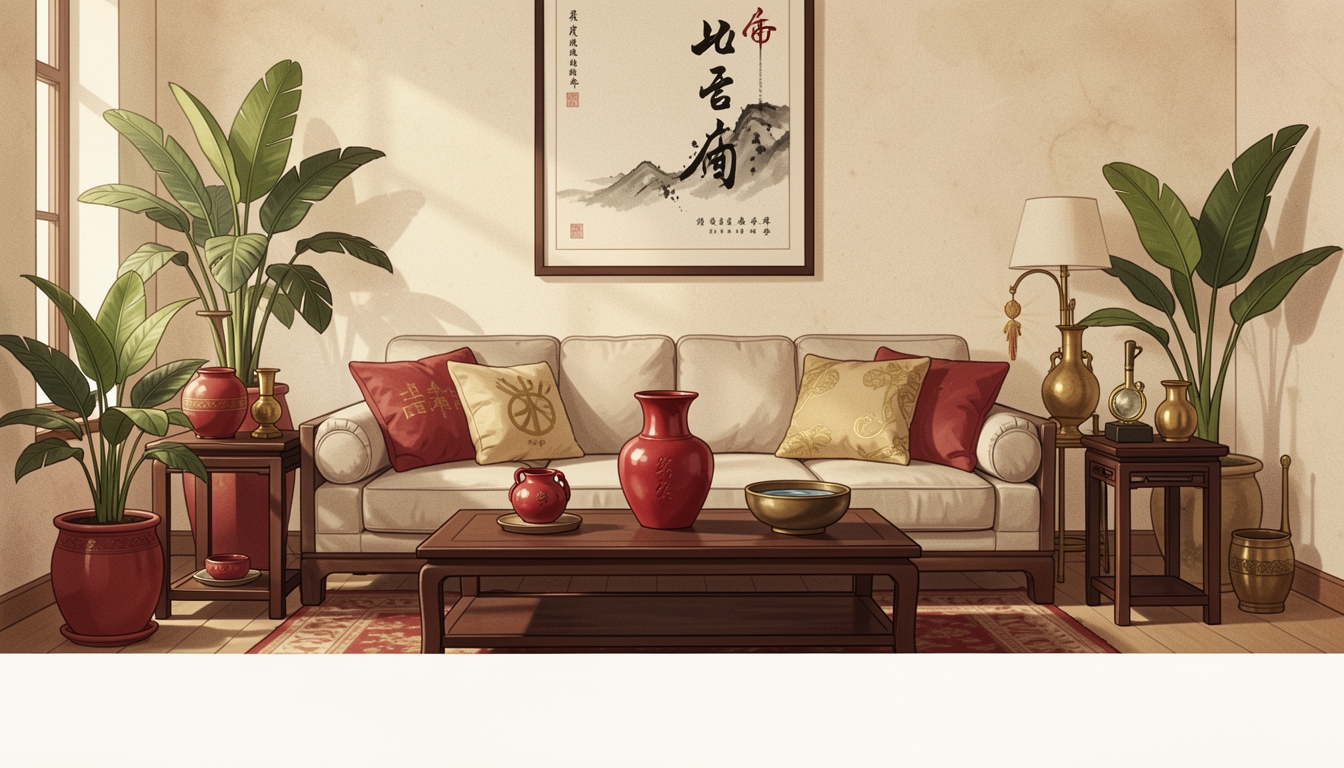
Feng Shui often feels abstract until you connect it to objects. The five elements give you a concrete way to read a room. Wood, Fire, Earth, Metal, and Water are not just symbols; they appear in colors, materials, shapes, and light. Once you can name which elements are strong or missing in a space, adjustments become simple.
What Each Element Looks Like in a Room
Wood appears as plants, vertical lines, and greens or browns. Fire appears as candles, warm light, reds and oranges, and pointed shapes. Earth appears as ceramics, square forms, and yellows or ochres. Metal appears as metals, white and gray tones, and round shapes. Water appears as mirrors, glass, dark blues and blacks, and flowing or wavy forms.
You do not need every element in every room. You need a working balance that supports how the room is used.
Balance by Room Purpose
A bedroom for rest benefits from calming Water and Earth, with soft colors and limited screens. A home office benefits from supportive Wood and Metal for growth and clarity, with enough order to keep Fire from becoming scattered. A living room for gathering benefits from balanced Fire and Earth, creating warmth without chaos.
When a room feels wrong but you cannot say why, check for excess: too much Fire (bright, cluttered, overstimulating), too much Water (cold, dark, heavy), or too much Metal (sharp, sparse, clinical).
Three Practical Moves
First, add the missing element in small doses: one plant, one warm lamp, one ceramic piece. Second, remove the excess element before adding anything new; decluttering is often the strongest single change. Third, place meaningful objects in the Bagua area that matches the life area you want to support. For details, see How to Use the Bagua Map.
Keep changes small and observable. Space responds to attention, not to frantic rearrangement.
Common Mistakes
The biggest mistake is treating the elements as a decorating quiz. The goal is not to include one of everything. The goal is to notice what a room supports and what it drains. The second mistake is ignoring light. Natural light is the fastest way to balance any space. The third is overthinking. If a change makes the room calmer and more usable, it is working.
FAQ
Do colors alone create an element?
Colors suggest elements, but material and shape also matter. A plastic red object carries less Fire than a candle flame.
Should every room have all five elements?
No. Balance depends on the room's purpose. Supporting the function of the room matters more than completeness.
What should I read next?
Read Feng Shui Basics: How to Use the Bagua Map for the spatial framework.
Where to Go Next
Continue with Feng Shui Basics, explore the Feng Shui section, or read The Five Elements Explained.