The five elements are one of the most important organizing ideas in Chinese metaphysics, but the word "elements" can mislead beginners. Wood, Fire, Earth, Metal, and Water are not a list of physical substances. They are five kinds of movement. Each one names a style of change and a pattern of relationship. Once that shift happens, the framework stops feeling abstract.
Elements as Movement
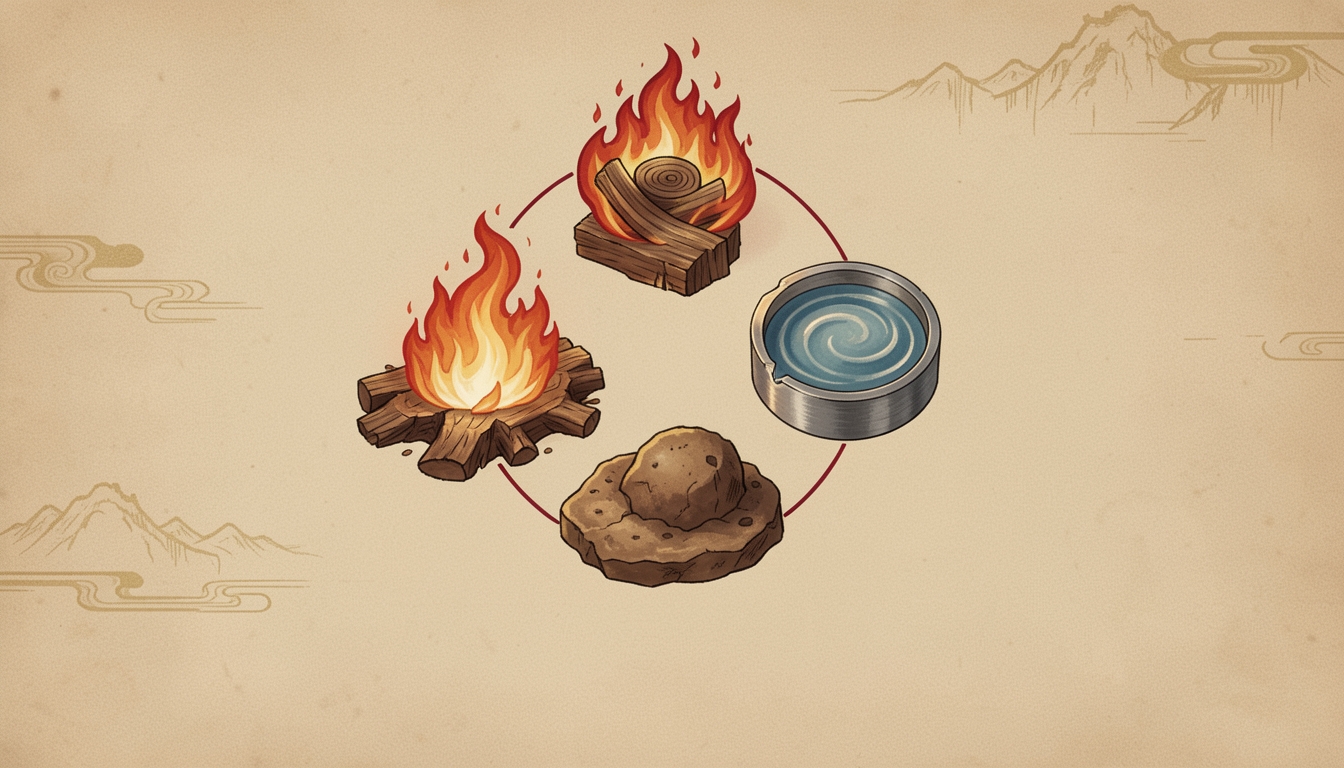
Wood suggests growth, extension, and reaching outward. Fire suggests heat, visibility, and expression. Earth suggests support, integration, and stability. Metal suggests definition, refinement, and boundary. Water suggests storage, depth, and adaptive flow. These are not poetic decorations. They form a working language used across Chinese metaphysics, medicine, and environmental reading.
The useful question is never "what object belongs to which element?" It is "what kind of movement does this element represent?"
The Generating Cycle
Beginners usually hear early that the elements generate and control one another. The generating cycle shows support and sequence: Wood feeds Fire, Fire creates Earth, Earth bears Metal, Metal carries Water, and Water nourishes Wood. This cycle describes how one quality gives rise to the next.
Understanding this sequence helps explain why a chart, room, or season can feel supported or strained. Elements are not isolated; they exist in relationship.
The Controlling Cycle
The controlling cycle introduces regulation: Wood parts Earth, Earth absorbs Water, Water extinguishes Fire, Fire melts Metal, and Metal cuts Wood. This is not about "bad" elements defeating "good" ones. It is about balance. Every element needs both support and healthy pressure to function well.
A room with too much Fire can be calmed with Water. A chart with too much Wood may benefit from Metal. The system provides a vocabulary for adjustment, not a moral judgment.
How Beginners Should Use This
Start by observing movement in daily life. What kind of day feels expansive? What kind of space feels grounding? Then practice naming those qualities with elements. You can see the same framework applied to rooms in Five Elements in Your Rooms and to charts in How to Read a BaZi Chart.
Do not try to memorize every correspondence at once. Movement and relationship come first; lists become useful later.
FAQ
Are the five elements meant literally?
No. They are symbolic categories of process and relationship, not physical objects.
Why exactly five?
The system uses five recurring modes of movement to describe many kinds of change. Its power comes from relationship, not from endless categories.
What should I read next?
Read What Are Yin and Yang? for the companion framework.
Where to Go Next
Continue with What Are Yin and Yang?, explore the general foundations, or open the BaZi calculator to see your own element balance.